The Cost to Change Your Mind
When you build with AI, the cost to change your mind stays low right up to launch. Good thing, bad thing, or just a thing?
How much does it cost to change your mind? When you build with AI, the answer is almost nothing, from the first idea right up to launch. I think that makes soloists and isolation the default on most teams... no need to talk as much any more, less collaboration, and less working together towards a common goal. I think that might mean we need to overindex on "team" or perhaps we won't have any semblance of meaningful relationships left at all.
Towards the inevitable
One of my favourite visuals of all time comes from Jeff Veen. I first saw him present it over two decades ago when talking about design, and my take on it was always "this happens in the accessibility world too". I revisited the concept recently in my talk "Accessibility & Inclusion in the Age of the Builder":
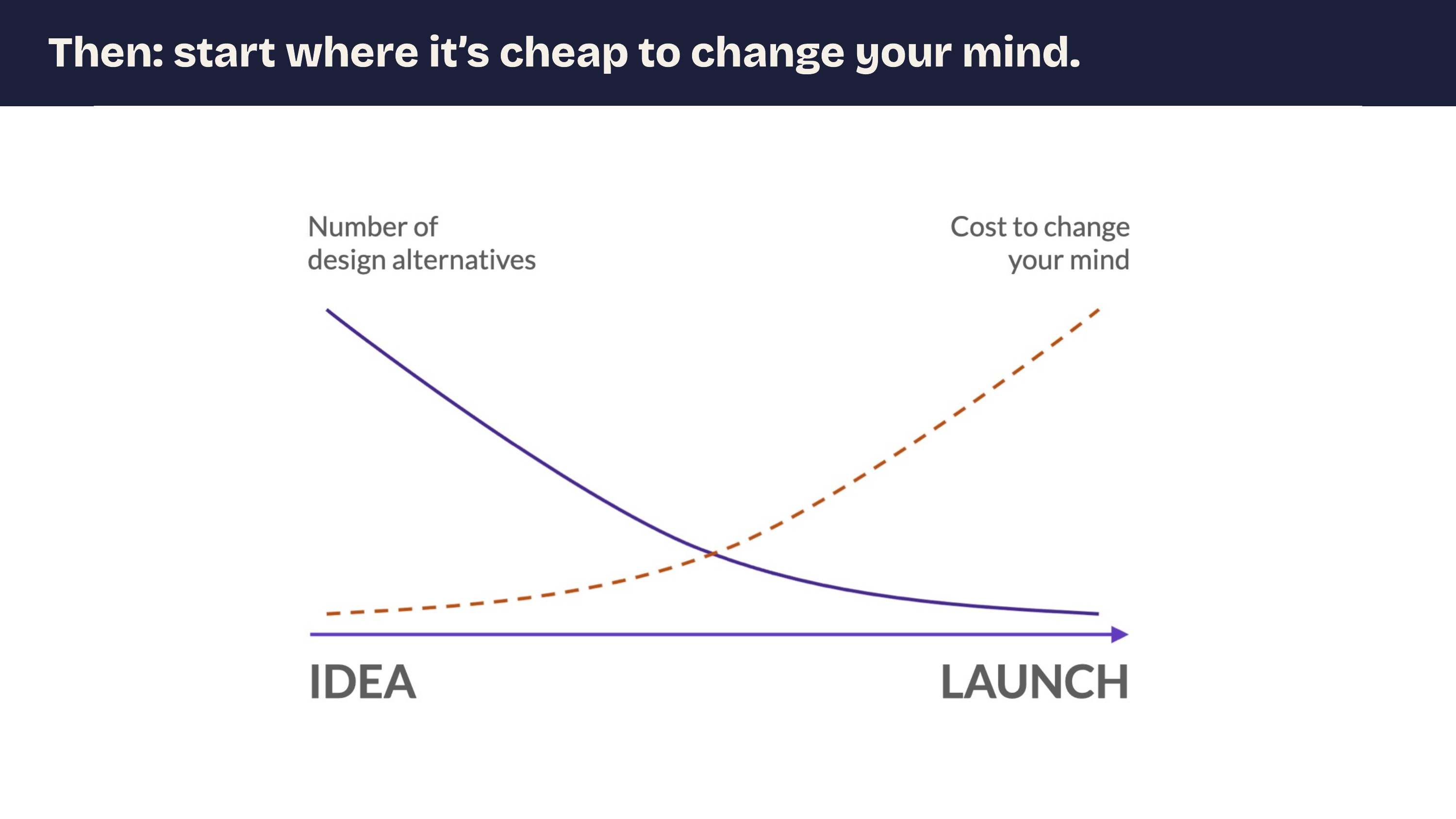
At the very beginning of a project, the number of design alternatives you can explore is at its maximum, and the cost to change your mind is at its minimum, simply because you haven't made any decisions yet. Over time those two lines cross. Every decision you make narrows the alternatives you have left and raises the cost of changing direction. As we move towards launch, the final design is, effectively, inevitable.
That graph explains a lot about how we work. We start with wireframes because a wireframe is a low investment and cheap to throw away. Paper and pencil was the medium for quick iterations, because producing a "final" design was expensive and much more difficult than a paper and pencil sketch. That's Production Friction: the basic cost of producing the digital asset.
That process also allowed for lots of discussion, collaboration, and working together. That's Productive Friction: the work that we do together, the debating of ideas, iterating on concepts together, that helps us figure out what we're designing and building... and also NOT designing and building.
Productive Friction helped to get the whole organization behind a common goal early. That alignment also served teams well because changing direction late was SO expensive.
Getting in early, because the cost to do it later is sky high, has been THE paradigmatic argument of the entire accessibility industry for years.
The economics of AI generated UI
What does that cost to change your mind and number of options curve look like now? I sketched it out in today's AI terms:
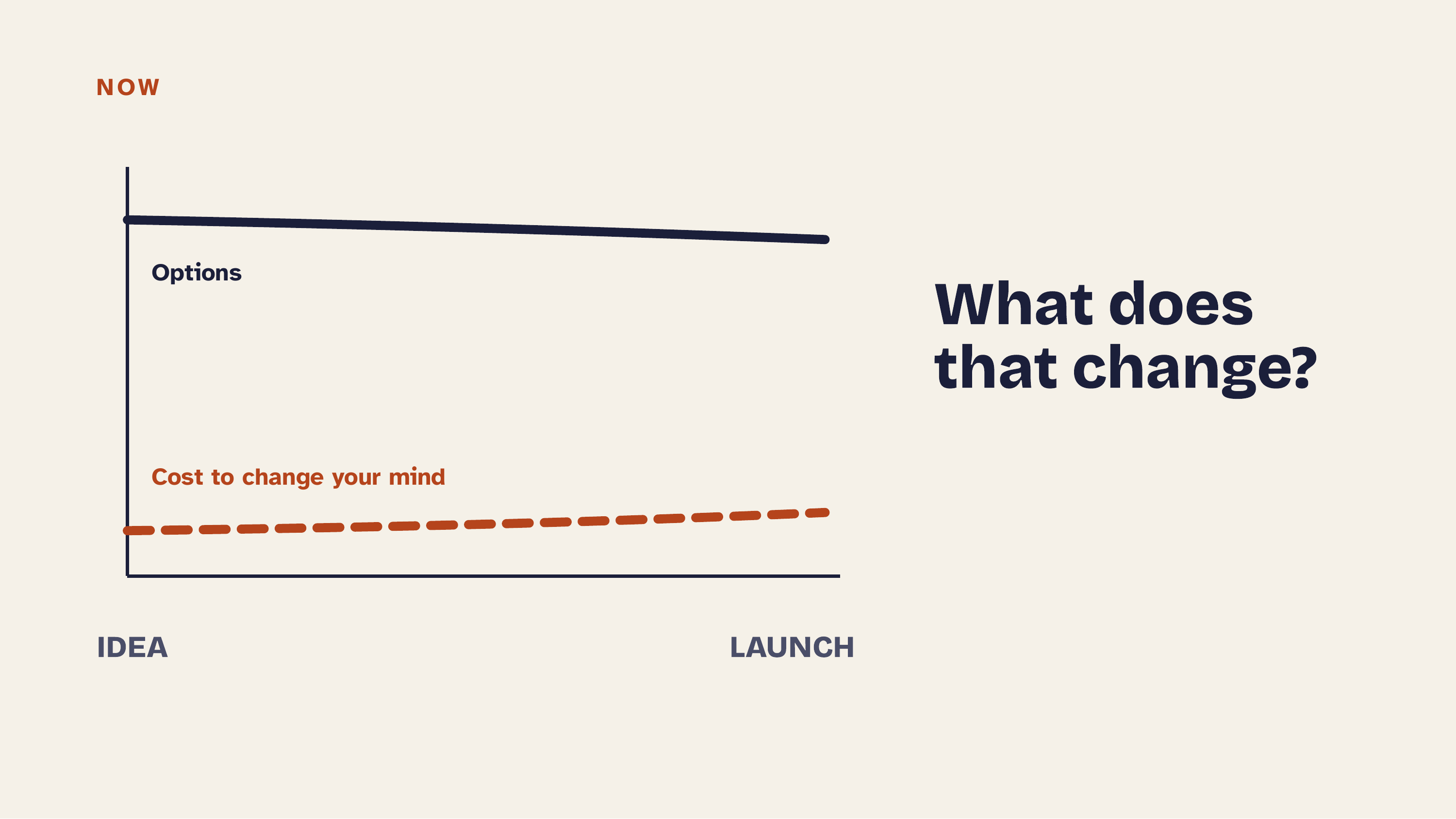
It's not literal, it's certainly not a complete picture, and the cost still rises toward launch. But generally speaking if we compare it at the same fidelity as the previous model, the cost to change your mind today is almost always low, with a lot of design alternatives open the whole way through the process.
"Have it ready for tomorrow!"
Something doesn't sit right with that last version of the graph though... and I think it was the labelling of the time axis... IDEA → LAUNCH. It feels like when the cost to change your mind is always low, and the options you have in front of you are always high... it kind of feels like constant ideation, never really moving towards launch.
With that feeling in mind, picture a leader or highly influential stakeholder proclaiming, at any time, "Change of plans! We're doing B instead of A. Have it ready for tomorrow!"
This was always a possible outcome in any process. But now, it CAN happen by tomorrow and the immediate cost is much less than in the past.
Software production became (mostly) inexpensive to change. I suspect the change is still expensive for the people around that change. Maybe even MORE expensive than before.
- The designer who argued for A finds their argument dismissed out of hand without discussion, because it was inexpensive to do so
- The accessibility pro who reviewed A may never see B at all, feeling less valued than before.
- The engineer that put time into A is completely side-swiped, and their job satisfaction plummets
Each time something like that happens, the team loses trust, and people get less willing to speak up next time. WHY feel invested in something when it can easily change at a moment's notice?
Are alignment and launch dead?
If you can change direction cheaply at almost any point, does getting everyone aligned early still matter? Or does it matter more?
What does a launch even mean when you're able to change your mind right near the very end?
It feels like we're moving from cross-functional teams to collections of soloists known as builders. In many cases it's easier to work alone... there's no resistance, no friction, no argument or debate. If all that's required for success is "look out for yourself and get things shipped" do we need to reward "plays well with others" and every other kind of collaboration? What do professional relationships even look like?
And... what is the role of the leader in all this?
(More next time on how I think this impacts accessibility)