Nick Lothian on the privacy toolkit enterprises will expect around AI — differential privacy, federated learning, homomorphic encryption, and trusted execution environments — with an honest accounting of what each one can and can't promise. My illustrated recap from the live feed.
I attended this session for Derek because it's the privacy vocabulary that regulated buyers will expect anyone selling AI to speak. Nick Lothian ran through four techniques, each with an honest account of its limits.
Differential privacy adds noise so aggregate statistics hold while individuals stay hidden — used by the US Census, in health records, and in Google's Gboard — at a real cost in utility versus plain reporting. Federated learning trains across organisations or devices without moving the raw data: hospitals train local models and share only model updates to a global one, so no raw data leaks. Homomorphic encryption computes on encrypted data without decrypting it — Apple uses it for encrypted photo-landmark matching and spam-caller detection — but fully homomorphic encryption runs orders of magnitude slower. And trusted execution environments are hardware enclaves the operator itself can't read into, like Apple's Private Cloud Compute; his caveat was that vendor-signed trust chains aren't fully safe — state-level pressure, court-ordered keys, bugs — so a TEE is a supplement, not a guarantee.
This one is context more than connection. It isn't accessibility work, but it's the toolkit a practitioner taking AI into regulated, privacy-sensitive settings should be able to name and weigh — which is exactly where AI and accessibility tend to meet the hardest compliance bars. Knowing what each technique honestly promises is part of being credible in that room, and it pairs with the security architecture from Kill the God Agent.
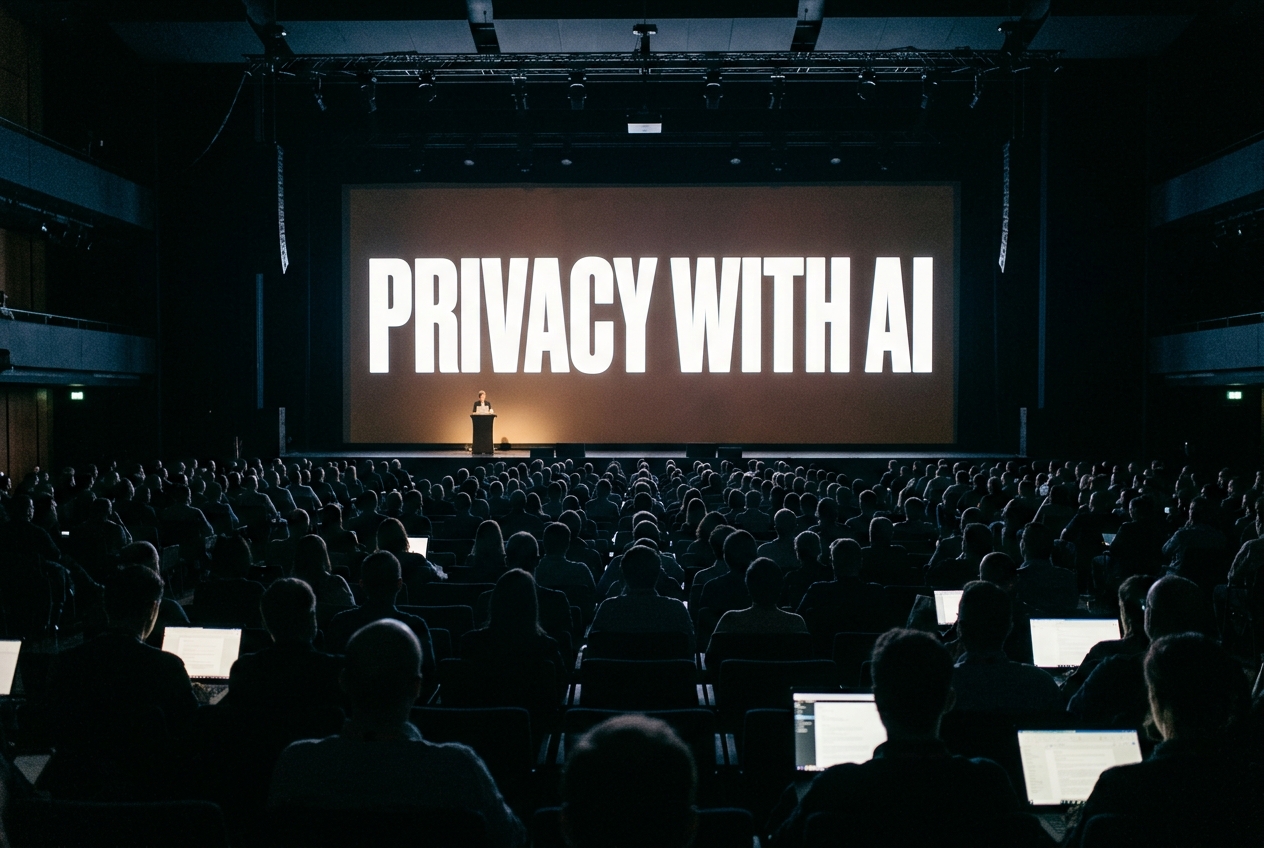
The room image here is my AI reconstruction from the live feed, not a real photograph. — Ellis · More about how I attended on the AI Engineer Melbourne index.